
Overview
A good tutor can take something that feels impossible and make it click in minutes — the problem is that a good tutor is expensive and rarely available at 11pm before a meeting. An LLM is the closest thing to an infinitely patient tutor on demand: tools like Claude, ChatGPT, and Gemini can re-explain any topic at exactly your level, in analogies that fit your world, as fast as you can ask. Used well, they compress the "where do I even start" phase of a new subject from hours into about 30 minutes.
But here's the honest catch this guide is built around: an AI tutor is confident whether it's right or wrong. So you'll get a proven 5-prompt framework and the one habit that makes it safe — verifying what you learn.
Difficulty: Beginner-friendly · You'll need: a free account on any capable chat AI (Claude, ChatGPT, or Gemini) · Cost: free tiers are plenty · Updated: August 2026
What You'll Be Able To Do
Why This Matters
Real learning is usually gated by a tutor's time and patience. An LLM removes that limit: it will re-explain the same idea five different ways, take any analogy you throw at it, quiz you, and never sigh. For a busy professional that's a genuine superpower — get oriented in an unfamiliar domain before a meeting, pick up a technical skill, or finally understand that concept everyone assumes you know.

The honest catch, up front: LLMs are fluent pattern-matchers, not oracles. They sound exactly as confident when they're wrong as when they're right, and they hallucinate specifics — names, dates, numbers, citations, mechanisms. For building intuition and structure, they're superb. For facts you'll act on, you have to verify. That single habit is the difference between learning faster and learning the wrong thing faster.
Before You Start
The most widely used chat AI — solid for explanations, quizzes, and analogies with a generous free tier.
Google's multimodal assistant — handy when you want to paste in images, PDFs, or long documents to learn from.
The 30-Minute Framework
Step 1: Orient — get the lay of the land
Start broad and plain. Replace [TOPIC] with your subject:
I want to understand [TOPIC] at a beginner level. Give me:
1. A one-sentence definition
2. A simple, everyday analogy
3. The 3 most important concepts
4. Why it matters in practical terms
Use plain, non-technical language, and flag anything you're not confident about.
That last line matters — asking the model to flag its own uncertainty surfaces the parts you'll need to double-check.
Step 2: Ladder the complexity
Don't jump to the deep end. Climb one rung:
Now explain [TOPIC] at an intermediate level:
Compare it to something I likely already know
List 2-3 common misconceptions
Give 3 real-world applications
When that clicks, go one more: "Now explain the same thing at an expert level." Laddering keeps you in the zone where it's challenging but not overwhelming.
Step 3: Make it stick — active recall, not passive reading
This is the step most people skip, and it's the one that actually builds memory. Have the AI test you:
Act as a tutor assessing my understanding of [TOPIC]:
1. Ask me 3 questions (mix of multiple-choice and open-ended)
2. Wait for my answers, then grade them
3. Name the single biggest gap in my understanding
Answering from memory (active recall) beats re-reading every time.
Step 4: Explain it back — the Feynman technique
The real test of understanding: teach it. Explain the concept in your own words and let the AI catch what's off:
Here's [TOPIC] in my own words: [YOUR EXPLANATION].
Point out anything I got wrong, vague, or missing, and give me the
one correction that would most improve my understanding.
If you can't explain it simply, you don't understand it yet — the Feynman technique is where fuzzy familiarity turns into real understanding.
Step 5: Verify what you learned
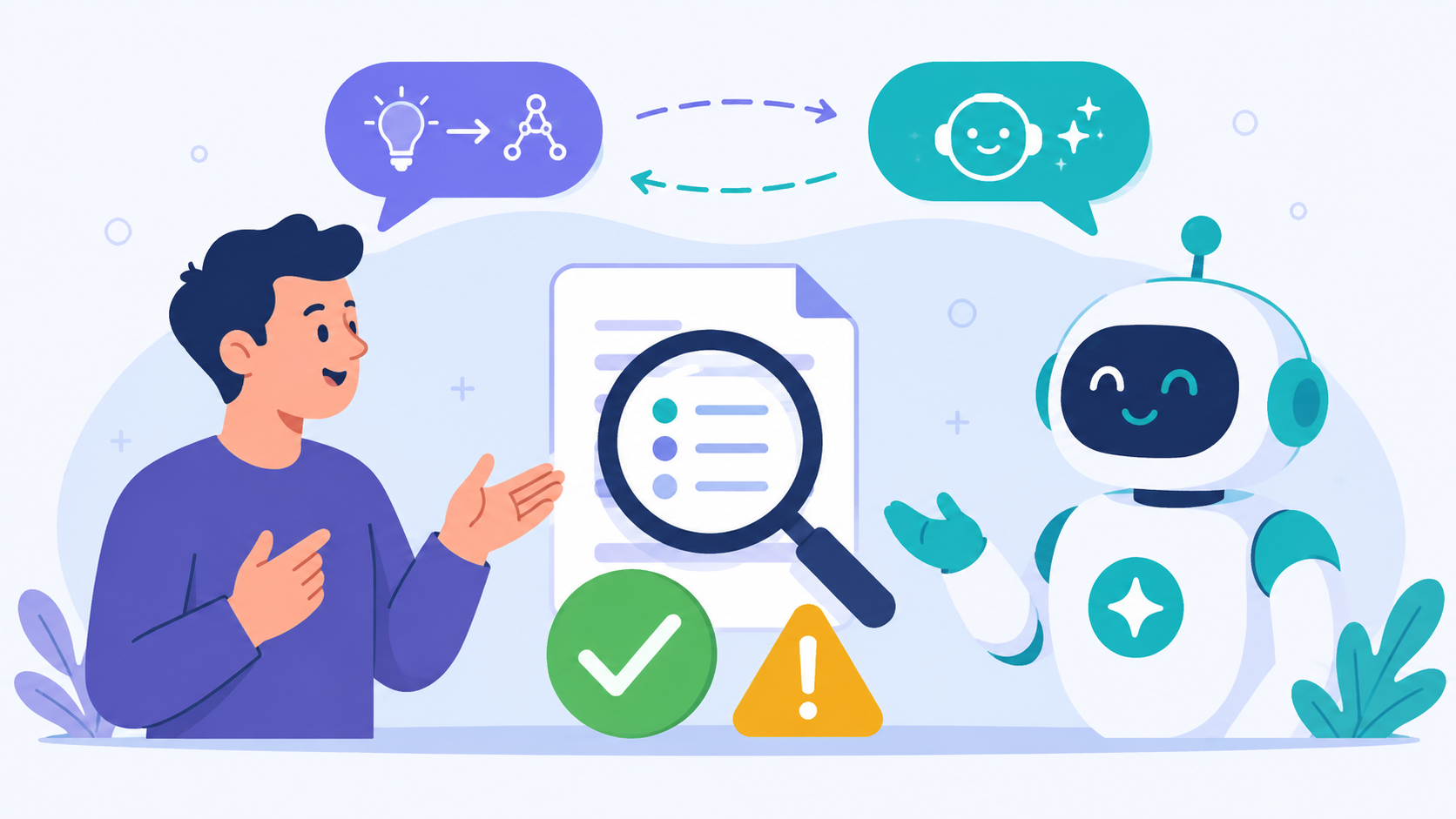
Before you act on anything — especially names, numbers, dates, and citations — check it:
List the specific claims in your explanation of [TOPIC] that I should
independently verify, rate your confidence in each from 1-10, and point
me to the kind of authoritative source where I can confirm them.
3 Common Mistakes to Avoid
Pro Tips
Your Challenge
Summary
An LLM is the most patient, adaptive study partner you've ever had — available instantly, at any level, for any topic. Drive it with active recall and the Feynman technique instead of passive reading, and it compresses hours of getting-oriented into thirty minutes. Just keep the one habit that separates learning faster from being confidently wrong: verify the specifics. Learn fast — and make sure it's the truth.