Introduction: Beyond the Chatbox
For years, we've interacted with computers by clicking buttons or typing rigid commands. Gemini represents a fundamental shift: a transition from computers that follow instructions to AI partners that understand context, intent, and creativity.
Think of Gemini not as a "smarter Google Search," but as a Reasoning Engine. It doesn't just retrieve information; it processes it, synthesizes it, and helps you build things. This tutorial is designed to take you from seeing Gemini as a novelty to using it as your primary engine for productivity and innovation in 2026.
What you'll learn
Section 1: What is Gemini?
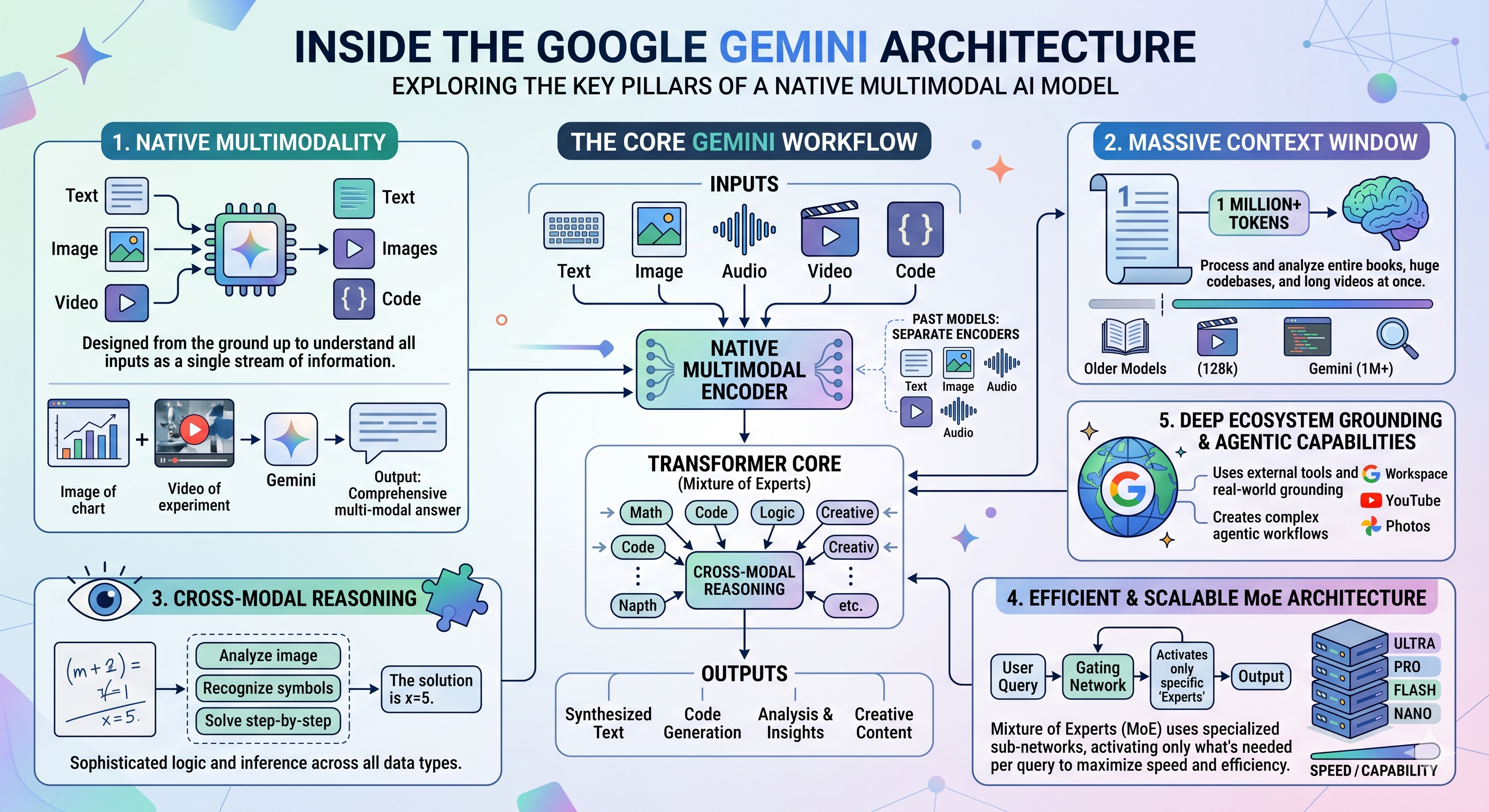
Gemini is Google's most capable and flexible AI ecosystem. Unlike early AI models that were primarily text-based, Gemini was built from the ground up to be multimodal. This means it doesn't need to "translate" an image into words to understand it; it understands pixels, soundwaves, and text simultaneously.
The Core Philosophy
Google designed Gemini to be a collaborator. While other AIs focus on being encyclopedic, Gemini is focused on utility. It is designed to live where you work—whether that's in a code editor, a spreadsheet, or a live video conversation.
Section 2: The Three Tiers of Intelligence
Not all tasks require the same amount of "brainpower." Gemini is distributed in different tiers to balance speed, cost, and complexity.
1. Gemini Flash (The Speedster):
The workhorse. Optimized for speed and efficiency. In 2026, Gemini 3 Flash is the standard for high-volume tasks like summarizing thousands of emails, real-time translation, and quick coding fixes.
2. Gemini Pro (The Professional):
The "goldilocks" model. It offers deep reasoning capabilities for complex problem-solving, creative writing, and sophisticated data analysis.
3. Gemini Ultra (The Specialist):
The most powerful model, designed for highly complex reasoning, scientific research, and advanced coding architecture.
Section 3: Native Multimodality
Most AI tools are "stitched together"—they use one model for text and "plug in" another model for images. Gemini is different because it is Natively Multimodal.
Why this changes everything:
Visual Reasoning: You can upload a photo of a complex circuit board and ask Gemini, "Why isn't this working?" and it can "see" the loose wire.
Video Understanding: You can give it a 10-minute video of a lecture and ask, "At what point did the speaker mention the 2026 fiscal policy?" and it will give you the timestamp.
Audio Fluency: It can listen to a meeting and distinguish between different voices to create an accurate transcript and action-item list.
Section 4: The Google Ecosystem Integration
Gemini's greatest superpower is that it isn't an island. Through Extensions, it connects directly to the tools you already use every day.
Section 5: Real-World Use Cases
In 2026, Gemini has moved beyond simple Q&A. It is now a core part of professional workflows:
Vibe Coding: Building functional web apps by simply describing the "vibe" and functionality, letting Gemini write the React or Python code in real-time.
Content Creation: Using Gemini to storyboard a video, generate the script, and then hand that off to the integrated Veo model to create the actual footage.
Strategic Brainstorming: Acting as a "Red Team" to find flaws in your startup's business model or marketing strategy.
Section 6: Grounding & Accuracy
One of the biggest hurdles for AI is "hallucination" (making things up). Gemini addresses this through a process called Grounding.
When you ask Gemini a factual question, it uses Google Search to verify its claims in real-time. It provides citations and links, allowing you to double-check the "source of truth." This transforms the AI from a creative writer into a reliable research assistant.
Section 7: The 2026 Creative Toolkit
Gemini now powers a specialized suite of creative models that you can access directly within the interface:
Nano Banana 2: The state-of-the-art image engine. It handles text-within-images and complex styles (like 80s City Pop or Vaporwave) with incredible precision.
Veo: The high-fidelity video model. It generates cinematic clips with natively generated audio.
Lyria 3: The music engine. It creates 30-second professional-grade arrangements for your podcasts or social media content.
Section 8: From Assistant to Agent
We are entering the era of AI Agents. An assistant answers questions; an agent completes tasks.
Gemini is evolving into an agent that can operate across multiple apps. Soon, you won't just ask Gemini to plan a meeting; you'll ask it to book the room, invite the participants, and prepare the briefing notes—all autonomously.
Closing thought
Gemini is a multiplier for your ambition. It lowers the barrier between having an idea and bringing that idea to life. In 2026, the question isn't "What can Gemini do?" but "What will you build with it?"