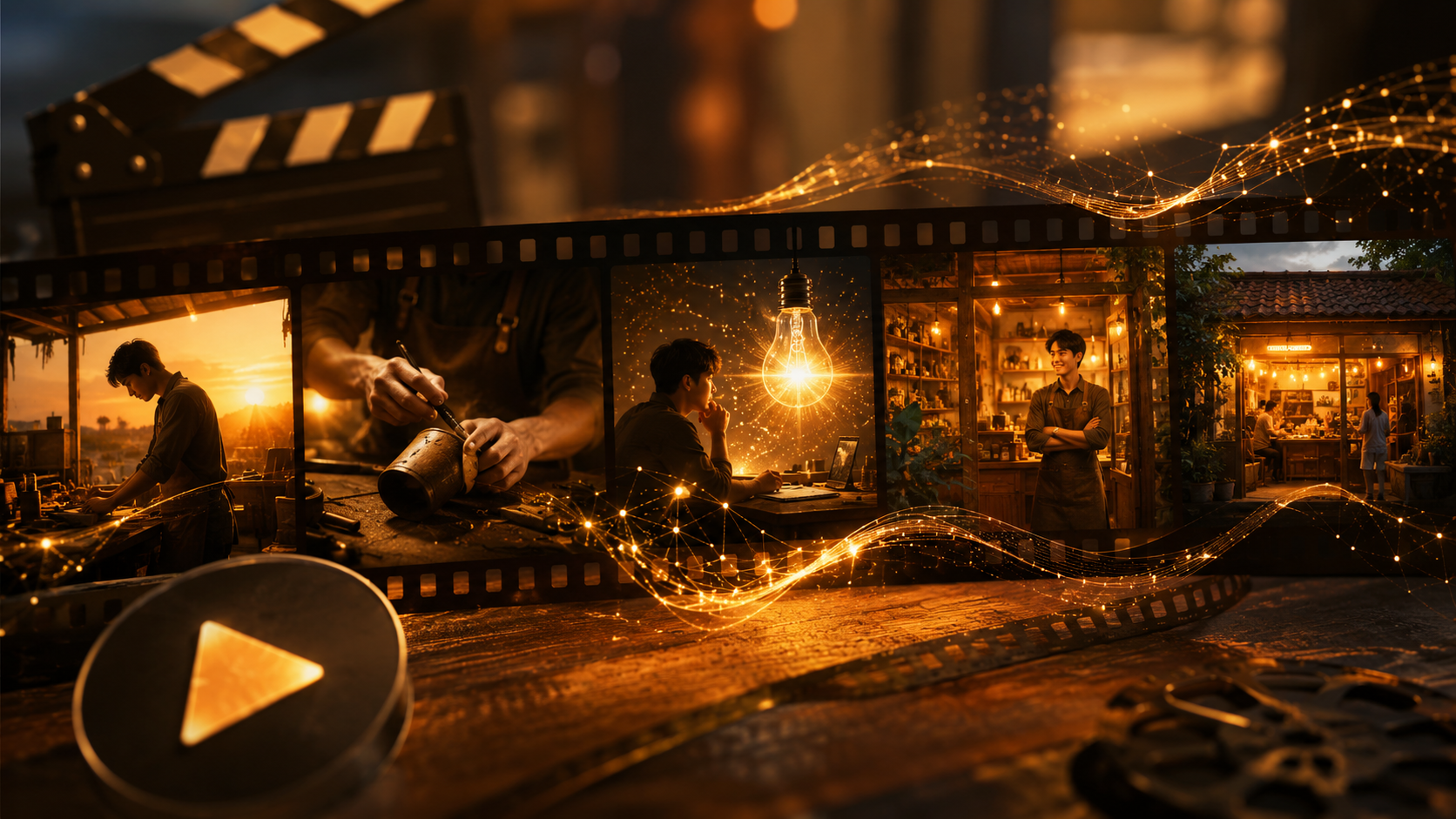
Build Cinematic Origin Stories with AI for Your Brand
Every brand has an origin story, and almost every brand wastes it on a lifeless "About Us" paragraph. Yet the story of why you started — the frustration, the failed first attempt, the moment it clicked — is the most persuasive marketing asset you own, because people don't fall in love with products, they fall in love with reasons. Until recently, turning that story into a genuinely cinematic short film meant a scriptwriter, a videographer, and a budget. AI collapses that: with a chat model, an AI video tool, and a voice generator, one person can turn a true origin story into a polished 60–90 second brand film in an afternoon.
This guide walks the whole pipeline — finding the real story, structuring it, scripting it with AI, generating the footage and voice, and assembling it — with one rule running through all of it: your origin story has to be true. AI is here to tell your real story beautifully, not to invent a fake one.
Difficulty: Beginner · Required tools: An AI chat model (Claude or ChatGPT) for the script — free tiers work. Optional for the full film: an AI video tool (Veo, Kling, Runway, or Sora), an AI voice tool (ElevenLabs), and an editor (Canva or CapCut). · Updated: July 2026
Overview
The reason origin stories work is simple: they give people a reason to care that a feature list never can. A candle company that says "natural soy wax" is forgettable; a founder who tells you they started because the store-bought candles that filled their home also filled it with chemicals — that you remember, and trust. Story is how humans have always transmitted meaning, and a brand origin story is just that ancient tool pointed at "why we exist." The craft has never been the problem for most founders; the production was. That's what AI changes.
The pipeline is now accessible to anyone. You mine your real story into a few pivotal beats, use a chat model like Claude or ChatGPT to shape them into a tight cinematic structure and script, generate visuals with an AI video tool (or mix in your own real footage and photos), add an AI voiceover and music, and assemble it in a simple editor. Each step that used to require a specialist now takes a prompt and a review. The result isn't a corporate explainer — it's a short film with a beginning, a low point, and a turn, that makes a stranger feel why your brand matters.
But there's a line that matters more than any technique, and the draft version of this topic blurred it, so let's be clear: use AI to tell the truth well, not to manufacture drama. A fabricated "rock bottom" moment or an invented backstory isn't a marketing tactic — it's a lie that will eventually cost you the trust the story was meant to build. Audiences have a finely tuned radar for fake authenticity, and a true small moment beats an invented grand one every time. The skill here is selecting and shaping the real beats of your actual journey, not inventing new ones.
The honest goal: by the end you'll have a repeatable system to turn your genuine origin story into a cinematic short — real beats, a strong three-act structure, an AI-drafted script you refine, and (if you want the full film) AI-generated visuals and voice assembled into a shareable 60–90 second video — without a film crew, and without faking a single thing.
Who This Is Useful For
What You Will Learn
What You Need
Step 1: Find the Real Story — Not the Polished Bio
Before any AI, do the human part: mine your genuine journey for the moments that actually matter. Forget the LinkedIn version. List, in plain words, the real turning points: the frustration or problem that started it, the leap, the failure, the moment it worked, where you are now. For a bakery founder that might be: grandmother's kitchen at dawn; getting laid off; baking a hundred loaves for neighbours during lockdown; opening the shop. Keep each beat short and true — you're finding raw material, not writing yet.
The counterintuitive truth is that small, specific, real moments are far more powerful than big, vague, impressive ones. "We're passionate about quality" is nothing; "I noticed the candles filling my home were also filling it with chemicals" is a story. Specificity is what makes a moment feel true, and truth is what makes an audience care. So dig for the concrete detail — the exact frustration, the literal first customer, the specific thing that broke — because those details are what no competitor can copy and no AI can invent for you.
This step is the one part AI can't do, and shouldn't. The beats have to come from your real life, because the entire value of an origin story is that it happened. Get these down honestly first, and everything downstream — structure, script, film — is just presentation of something real.
Pro tip: Pick the single moment you'd be slightly reluctant to share — the failure, the doubt, the unglamorous start. That's almost always the most powerful beat, because vulnerability is what makes a story feel human and trustworthy. The polished wins are forgettable; the honest struggle is what connects.
Step 2: Shape the Beats Into a Three-Act Arc
Raw beats aren't a story yet — structure is what turns a list of events into something that moves people. The most reliable shape is the classic three acts: Act 1 establishes the ordinary world and the problem or spark; Act 2 is the struggle — the attempts, the failure, the low point; Act 3 is the turn and where you are now. The emotional engine is the low point into the turn: a story with no struggle is a brag, and brags don't connect. Your rock-bottom moment (a real one) is what makes the resolution land.
Choose one symbolic motif to thread through it — a single recurring image or object that carries meaning: dawn light for the baker, a worn hiking boot, a family recipe card, a first broken prototype. A motif is what elevates a sequence of events into something that feels cinematic, giving the audience a visual thread to hold. Pick something that's genuinely part of your story, and let it appear at the start, the low point, and the end. This is also the moment to decide length and focus: a brand film wants 60–90 seconds and 3–5 beats, not your whole life story.
Nailing the structure before you write is what keeps the AI on track later. If you hand a model a clear arc — spark, struggle, low point, turn, now, with a motif — it produces something coherent; if you hand it a pile of unordered facts, it produces mush. The structure is yours to decide; the AI's job is to render it well.
Pro tip: Find your "false start / real turn" pair — the moment it seemed to fail and the moment it actually worked. That contrast is the beating heart of almost every great origin story. If you can name those two moments, you have your Act 2 low point and your Act 3 turn, and the rest of the structure falls into place.
Step 3: Draft the Script With AI — From Your Truth
Now bring in the chat model, with your beats and structure in hand. A model like Claude or ChatGPT is excellent at turning ordered real moments into a cinematic script — but only as good as the beats you feed it, so give it the truth and let it handle the craft. A strong prompt names your real beats and asks for film structure explicitly. For example:
That last line matters: instruct the model not to fabricate. AI will happily add a dramatic flourish that never happened if you let it, and that's exactly what you don't want. Then refine conversationally — "make the low point quieter and more real," "cut the adjectives, let the facts carry it," "this line sounds like an ad, make it sound like me talking." Two or three passes turn a decent draft into something that sounds like you and stays true.
Read every line against reality. The script should feel like a heightened, well-told version of what actually happened — never a fictionalized one. If a sentence makes the story better but less true, cut it. The whole asset only works because it's real.
Pro tip: After the script is written, paste it back and ask: "Which claims or events here did I not actually give you? Flag anything you inferred or embellished." It's a fast way to catch invented details before they end up in your brand's film — the model will usually own up to what it added.
Step 4: Turn the Script Into a Shot List and Storyboard
A script tells you what's said; a shot list tells you what's seen — and it's the bridge to actually making the film. Ask the AI to break your script into scenes and shots: for each beat, what's on screen, the type of shot (wide establishing, close-up, montage), and the mood. Now your motif becomes concrete — you decide exactly where the dawn light or the worn boot appears. This turns an abstract script into a build plan, and it's what keeps the visuals coherent instead of a random collection of AI clips.
For a storyboard, generate a keyframe for each shot with an AI image tool (Nano Banana, Midjourney, or similar), or sketch them roughly — the point is to see the film before you make it. Decide here how much will be AI-generated video versus your own real photos and footage; often the most powerful origin films mix them, using real photos of the actual early days alongside AI-generated cinematic shots for moments you couldn't capture. Planning the visuals now saves you from generating twenty disconnected clips and trying to force them together later.
Treat the shot list as the thing that keeps everything consistent. Style, palette, and motif decided here — "warm, grainy, golden-hour throughout" — become the instructions you'll reuse for every generated shot, which is what makes the final film feel like one piece rather than a patchwork.
Pro tip: Decide one consistent visual style up front (palette, film-grain look, lighting) and repeat it in every image and video prompt. Consistency is what separates a real short film from an obvious AI mishmash — the same warm, slightly grainy look across every shot does more for "cinematic" than any single fancy clip.
Step 5: Generate the Cinematic Footage
With a shot list, generate the visuals. AI video tools — Veo, Kling, Runway, Sora — can turn a shot description into cinematic footage: "a wide, golden-hour shot of a small bakery at dawn, warm grainy film look, gentle camera push-in." Work shot by shot from your list, feeding each the same style cues so the film stays coherent. For moments you have real footage or photos of — the actual first product, a real old photo — use those; authenticity beats generation, and a genuine grainy photo of day one often lands harder than a perfect AI shot.
Keep two things in mind. First, consistency is the hard part — reuse your palette, lighting, and motif language in every prompt, and where a tool supports references or a consistent style, use it, so shot three looks like it belongs with shot one. Second, generate more than you need and cut ruthlessly; AI video is hit-or-miss per generation, so a few tries per shot and keeping only the best is normal. The goal is a handful of strong, cohesive shots, not a pile of impressive-but-mismatched ones.
Don't chase perfection per clip at the expense of the whole. A film of five consistent, on-tone shots beats one of ten dazzling-but-clashing ones. The story and the coherence carry it — individual shots just need to serve the beat they're on.
Pro tip: Match your generated shots to the emotional arc, not just the literal script — darker, stiller, tighter framing for the low point; brighter, wider, moving shots for the turn. Letting the look follow the feeling is what makes it read as a real film rather than a slideshow of nice images.
Step 6: Add Voice, Music, and Sound
Voice and sound are half of "cinematic," and AI makes both accessible. For narration, an AI voice tool like ElevenLabs can deliver your script in a warm, human voice — or record it yourself, which for a personal brand is often the most powerful choice, since your actual voice telling your actual story is as authentic as it gets. Match the delivery to the tone you set: grounded and sincere, not the breathless movie-trailer voice. The voiceover is the emotional spine; let it breathe, with pauses where the story earns them.
Layer in music and sound design, because they do the emotional heavy lifting audiences never consciously notice. A single well-chosen piece of music that swells at the turn will move people more than any visual; the sensory sounds you scripted (a mixer whirring, an oven timer, rain on a tent) ground the story in something real. Use royalty-free or AI-generated music, keep it under the voice, and let it rise at the emotional peak. Pacing matters more than length here — a 75-second film that breathes beats a 3-minute one that drags.
Get the audio right and a modest set of visuals suddenly feels like a real film; get it wrong and even great footage feels flat. Sound is the cheapest, highest-leverage upgrade in the whole pipeline, so give it real attention rather than treating it as an afterthought.
Pro tip: For a personal or founder brand, seriously consider narrating it in your own voice, even if it's not "perfect." A slightly imperfect real voice telling a true story out-connects a flawless AI voice every time — the tiny imperfections are the authenticity. Save the AI voice for brand films where no single founder is the face.
Step 7: Assemble, Tighten, and Keep It True
Bring it together in a simple editor — Canva or CapCut both work with no experience needed. Lay your shots against the voiceover, drop the music underneath, and cut to the rhythm of the narration. The single most important edit is to make it shorter: almost every first cut is too long. Trim to 60–90 seconds, cut any shot that doesn't earn its place, and end on the turn — where you are now — leaving the viewer with the feeling, not a sales pitch. A tight film that leaves them wanting more beats a complete one that loses them halfway.
Then do the final and most important check: is every second of it true? Watch it as a skeptical stranger and ask whether anything is implied that didn't happen, any moment dramatized past reality, any claim you can't stand behind. This is where a brand film is made or quietly broken — because the whole reason an origin story works is that it's real, and the moment an audience senses fabrication, the trust you built inverts into suspicion. Cut anything you can't fully stand behind, even if it's the best-looking shot.
Finally, make sure it actually feels like your brand: the tone, the values, the visual style should match everything else you put out, so the film deepens your identity instead of feeling like a one-off. Then ship it — put it on your About page, your launch, your socials — and reuse the system for the next story.
Pro tip: End on a real, forward-looking note rather than a call to action — the thing you're still working toward, the mission that isn't finished. Origin stories are about why, and leaving the viewer with an unfinished mission invites them to be part of it, which converts far better than "buy now" tacked onto an emotional film.
Common Mistakes to Avoid
Fabricating or over-dramatizing your story. The fatal error. An invented rock-bottom moment, a made-up statistic, a dramatized event that didn't happen — these aren't storytelling, they're lies that destroy the trust the film was meant to build. AI makes fabrication effortless, which is exactly why you must forbid it. Tell your real story well; a small true moment always beats a big fake one.
Overstuffing the timeline. Cramming ten events into 90 seconds produces a rushed highlight reel with no emotional arc. Pick 3–5 pivotal beats and one clear low-point-to-turn spine. If you're unsure, ask the AI which events could merge — but ruthlessly cut, because focus is what lets a single moment actually land.
Generic, inconsistent AI output. A pile of dazzling-but-mismatched AI clips and a breathless stock voice reads as "AI made this," not "a real film." Lock one visual style and reuse it across every shot, keep the voice grounded, and mix in real photos and footage where you have them. Consistency and authenticity, not per-clip flash, are what make it cinematic.
Going Further
Once you've made one, the system scales. Reuse the pipeline for every story your brand has — customer success stories, product-development journeys, team-member spotlights all follow the same beats-to-film flow. Build a style kit — your palette, film-look prompts, voice choice, and music — so each new film is faster and your brand stays visually consistent across all of them. Mix real and generated more deliberately as you improve, using genuine archival photos for the true early days and AI for the cinematic connective tissue. And study story structure itself — the better you understand three-act arcs, motifs, and the low-point-to-turn engine, the less you rely on AI to save a weak structure. The durable skill isn't "using an AI video tool" — it's knowing how to find and tell a true story that makes strangers care, which is the oldest and most valuable marketing skill there is.